

















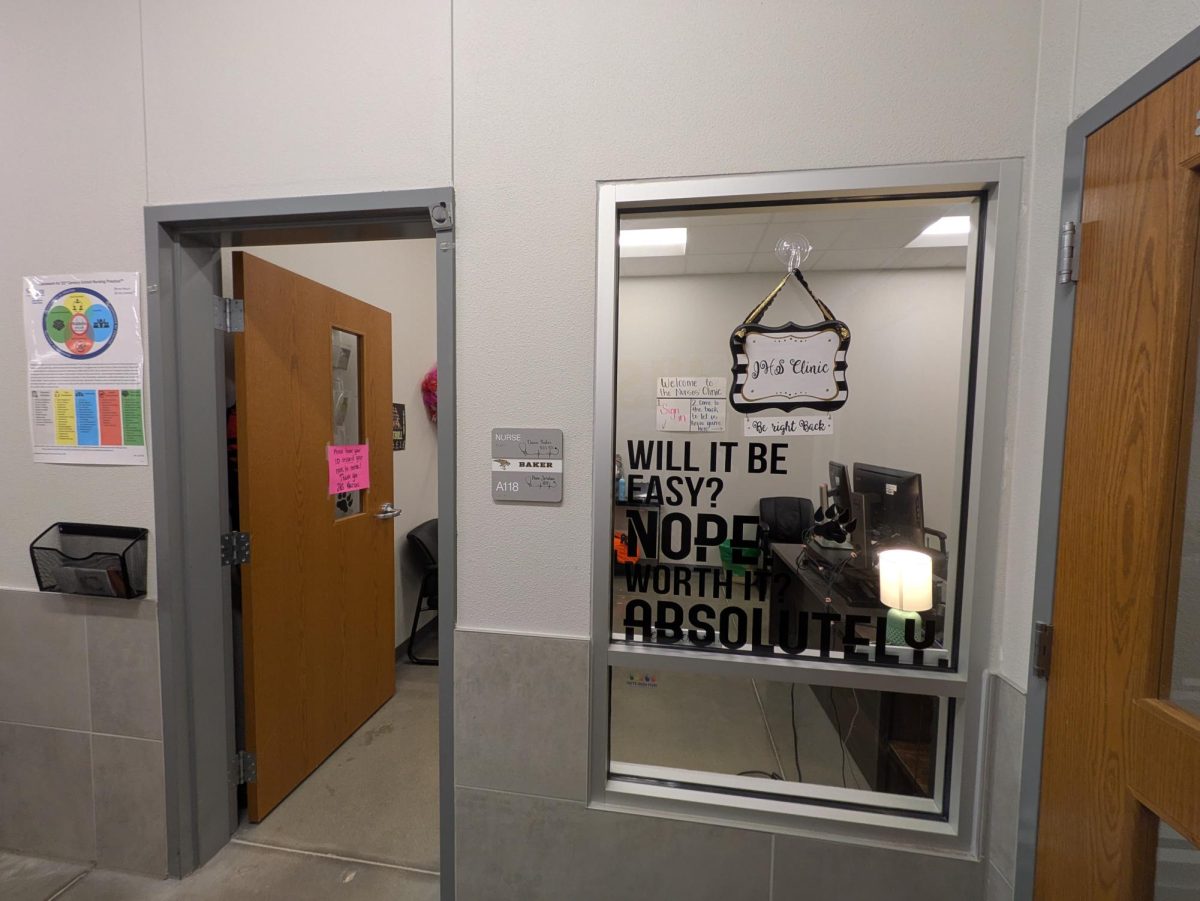
Students have certain expectations about the care they can receive from the nurse when they are feeling unwell at school. There are a lot of misconceptions about what that care can look like, but JHS nurses Dawn Baker, RN and Pam Jordan, LVN have been given the opportunity to explain the regulations governing the nurse’s care.
School nurses are allowed to treat students only to a limited extent. Their most important job is to provide first aid in the event of a student or staff member having a medical emergency. Beyond that, they also work with individual students who have a chronic illness or disability and have been issued a 504 plan or IEP. Students, or their parents, will have their doctor send orders to the school nurse for what medicine the student can take and if the nurse needs to have emergency medicine on hand.
For more moderate, average check-ins students come for (a headache or bloody nose), there is not much the nurse can do. Besides answering health-related questions, they can check for fever temperatures and vital signs, provide menstruation products or an ice pack, and allow 10-15 minutes resting periods inside the office on one of three beds.
Notably, nurses are not able to supply over the counter drugs like Ibuprofen and Tylenol. This can be a source of frustration for students, particularly for those who suffer from menstrual cramps. The reason, though, is not a deliberate antagonization; Hays CISD policy forbids any exchange of pills. This may be related to the district’s history of students being harmed by lethal drugs.
“It’s just policy,” Baker said. “Some of us have given cancer drugs, so not being able to give Tylenol kind of makes us feel like our hands are tied. That’s just Hays CISD policy.”
Students can still get pain medication if their parents bring it to the school and administer it themselves. However, students are not allowed to carry it in their bag during the day. If a student expects to need medication at school, including over-the-counter, they can have their doctor send orders to the nurse for them to hold inside the clinic. Students whose doctors have sent orders to the nurse and have a parent-signed permission form may then pick up their medication as needed. The policy restricting student access to painkillers is justified as a safety precaution.
“I also think that a big thing could be like, if you come in every day for Tylenol, why?” Jordan said. “What’s the reason for it if, let’s say, you have a chronic issue and you’re not going to the doctor and getting checked out or whatever and you’re just coming in? It’s a safety procedure.”
Though the nurses can’t offer much in the way of cramp relief, they do offer the use of their microwave. Students can bring a heating pad from home and stop by the office to have one of the nurses warm it up for them.
The issue students like junior Nevae Hornelas have with the nurses is the perceived lack of attentiveness to students. This can be especially frustrating for students when care defaults to the stereotypical “grab an ice pack and go” or “lay down and take a nap.” These are lackluster responses many young patients are subjected to at least once in their life.
“And I think the reason for this is because they have so many students to tend to, and there’s only two nurses there,” Hornelas said. “So, it’s hard for them to take a good amount of time for each student to figure out what’s wrong with them.”
Students suggested another issue with the nurse’s office: location.
“I actually have never been to the nurse’s office because I did not know where the nurse was for all the four years I’ve been here,” senior Lyrika Van Vliet said. “Maybe there needs to be some work put into outreaching, where you can find help and what exactly you can get help with there.”
Wherein a lot of cases in the United States, this stands as an effect of low school nurse funding. From a recent study by The Relentless School Nurse, nurses’ budgets are increasingly being cut at the rise of tax breaks, forcing many to migrate back and forth between several schools. Divulged in a 2025 article by American Association of Colleges of Nursing, the Department of Health funding was cut by 6% due to a 2026 spending bill election by a vote of 35 to 28.
Ultimately, the nurse’s office exists to respond to medical emergencies on campus, and supply standard care for the sick or chronically ill. Anything beyond those two functions is auxiliary. As long as a student is not experiencing a serious medical issue, they are left largely on their own to manage pain and discomfort.
“We’re in a high school where we’re trying to encourage accountability, growth, and maturity,” Baker said. “We have a lot of kids—we have pregnancies, and drug problems. I mean, there’s just so many more things that we’re involved in than just band-aids and ice packs. And I think a lot of people don’t even realize that.”